


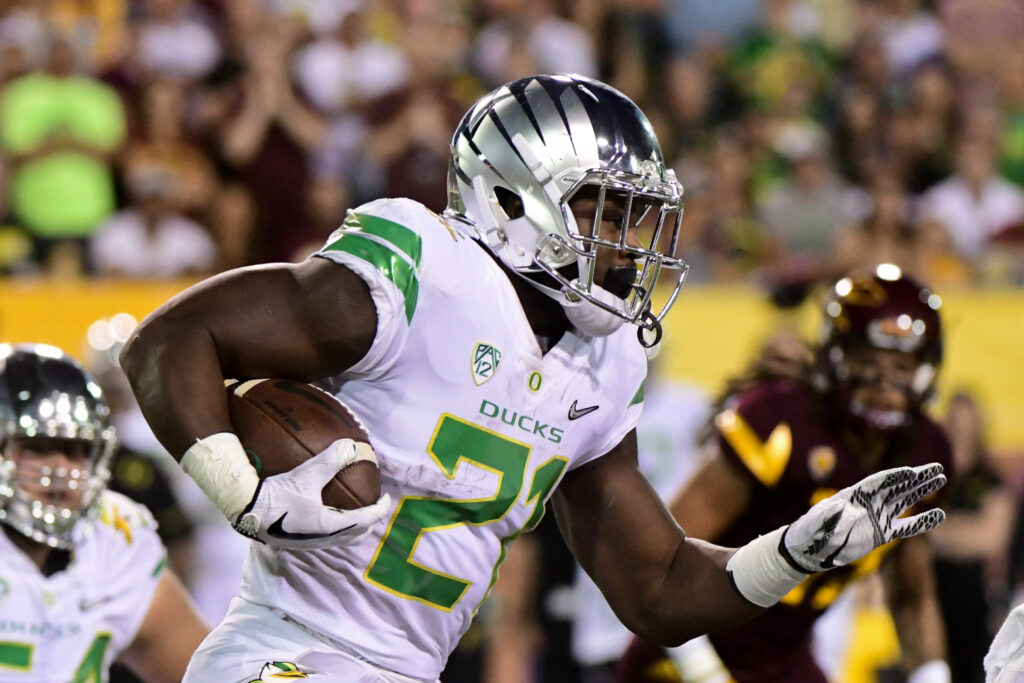
ENGLEWOOD, Colo. — Along with touting his “tremendous career” at the University of Oregon, John Elway used a simple explanation to describe the Denver Broncos third-round pick.
“He’s a big, physical runner who will fit in well in our backfield,” John Elway said on Twitter shortly after selecting Royce Freeman.
Standing at 6-feet and 229 pounds, Freeman’s big body, and hard-nosed running style create an unmistakable comparison to the man he was drafted to replace: C.J. Anderson.
After a short conversation with Denver’s newest running back, that comparison became even more credible.
“I can do a lot of things. I can do a lot of power, but I also feel like I have the ability to get to the outside,” he said with confidence. “As far as getting out of the backfield, I feel like I can do it all. I feel like I can block, split out wide and go out and catch the ball for the team, and I can get the check-down. Anything you can do in the passing game, and however you can be utilized, that’s what I can do.”
Statistically, both Freeman and Anderson racked up most of their production on the ground, while also flashing their ability in the passing game. However, along with their size, the most accurate comparison between the two could be their ability to protect the quarterback — a crucial trait for any running back looking to get playing time in the NFL.
“In pass-blocking, I’m able to use my size very well,” Freeman said, selling his abilities to the Denver media moments after being drafted. “I feel like I can hold down space and I also can use my size to block guys that maybe some other backs can’t.”
Another unmistakable trait the two big backs share is their head-hunting mindset.
“I want to be the one to deliver the blow, and I think as a running back, that’s definitely important,” Freeman said as his smile was felt over the phone.
A key difference between the two, however, is their production. While at times throughout his five-year career with the Broncos Anderson had unbelievable stretches, his downfall was his streakiness.
Freeman, on the other hand, was the gold standard for consistency and production. After his four-year career at Oregon, he became the Pac 12’s second all-time leading rusher with 5,621 yards and the conference’s all-time leader in rushing touchdowns with 60.
Sure, the NFL and college aren’t equal playing fields, but Anderson’s collegiate production — 1,135 career rushing yards — drastically falls short to Denver’s brand new luxury vehicle.
Another difference, courtesy of Elway, is that “Rolls Royce” is faster.
With plenty of wear on his legs, Freeman isn’t concerned he’ll slow down as the carries continue to rack up.
“You make sure that you do all you can do to take care of yourself,” Freeman said, sharing his secrets to longevity. “Go in for treatment and make sure you’re taking care of your body first because it is your vessel and your tool that you have in this game. That’s helped me get have the production that I have so far in my career.”
Now, with C.J.’s spot up for grabs, Freeman will come in and compete with Devontae Booker and De’Angelo Henderson for the starting spot and playing time.
“I feel like I have a chance to go in there and compete with other running backs that are there. They have a pretty good running back corps there already. Just being there and competing with those guys.”
Less than a month after the team sent C.J. Anderson packing; they brought in his replacement that’s not all too different.

0 Comments (2 conversations)
Litvakski
Where do you see this guy fitting into the team? For me I see him and Booker rotating in about 40% each with then Henderson filling in for that last 20% with hopefull big play potential. I just want to see a fair competition this off season with truly the best players getting to play.
Mark in Hawaii
Good stuff Zac. Thanks for filling us in on the similarities and the differences between C.J. and Royce. Anderson’s inconsistencies were maddening so I do hope Royce maintains his steady production week in and week out. I think the running back by committee the Broncos employ helps to manage the “wear” issue, to keep the backs fresh and extending their tread. Obviously the back thatnshows the most reliability in passpro and in the receiving game should take the lead back role, leaving the remaining carries to the 1B and the change of pace back. I know its early but whats your early prediction on how you envision the load will be split out?
Thanks
Mark